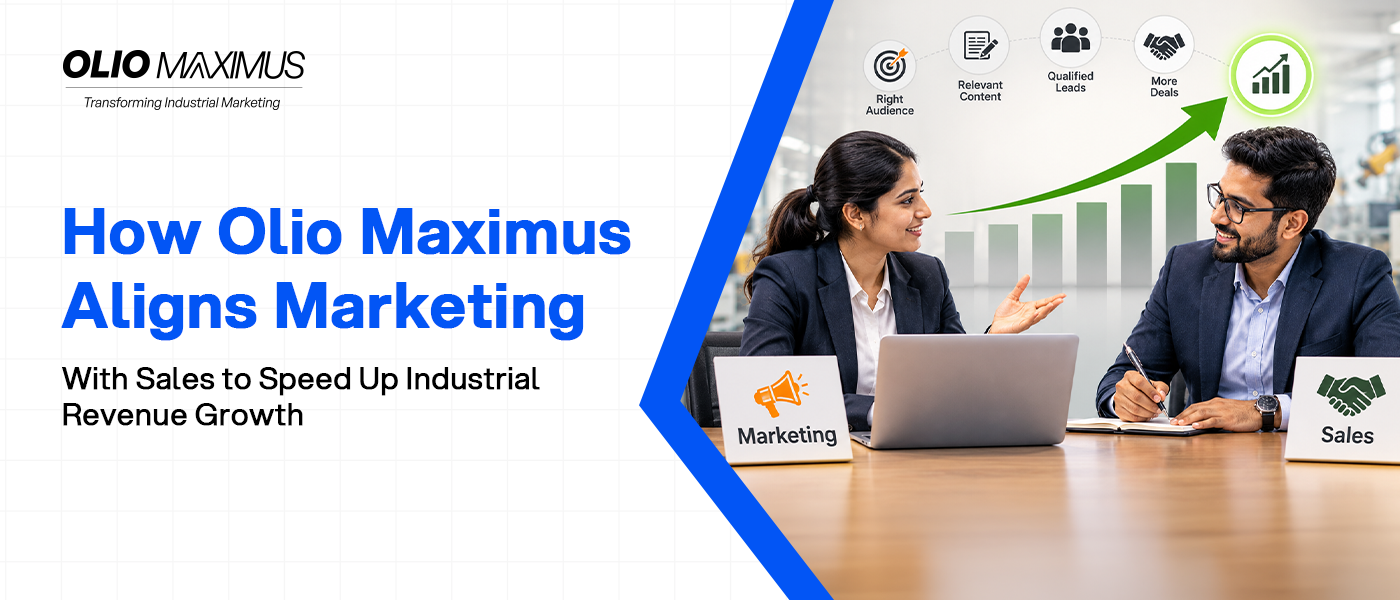
Marketing is getting a constant stream of enquiries. Sales are of the view that the majority of those aren't going to be worthwhile. The campaigns generate visibility, but the sales pipeline is still very much in a state of flux.
This is a common situation in industrial businesses. The marketing team focuses on bringing prospects in, while the sales team focuses on converting opportunities.
Without shared objectives, clear lead qualification, and consistent feedback, both teams can work hard and still fail to achieve the commercial results the business expects.
Effective manufacturing sales alignment goes beyond improving communication between departments. It connects buyer targeting, demand generation, lead qualification, and sales enablement around shared revenue objectives.
Olio Maximus builds this connection through an integrated industrial growth system. The objective is to help manufacturers attract relevant decision-makers, create sales-ready opportunities, and give sales teams the support they need to move conversations forward.
The Five Components of Marketing and Sales Alignment
Marketing and sales alignment requires a connected process rather than isolated departmental activities.
The Olio Maximus approach brings together five integrated components that support the journey from identifying potential buyers to improving revenue performance.
Component | Primary Objective |
|---|---|
01. Market Intelligence | Identify ideal customers, target industries, and buying opportunities. |
02. Demand Generation | Attract relevant industrial buyers through coordinated marketing channels. |
03. Pipeline Creation | Convert buyer interest into qualified sales opportunities. |
04. Sales Enablement | Equip sales teams with relevant information and resources. |
05. Intelligence and Optimisation | Connect marketing performance with pipeline and revenue outcomes. |
These components work together to create a more coordinated approach to industrial growth.
Why Marketing and Sales Often Work in Silos in Industrial Businesses
Industrial buying decisions rarely happen after one advertisement, website visit, or sales conversation.
Engineers, procurement teams, plant managers, and finance stakeholders may all influence the final decision. Evaluation can continue for months before a purchase is approved.
When marketing and sales operate independently, several problems emerge.
- Different definitions of a good lead: Marketing may count form submissions as success, while sales looks for prospects with a relevant application, budget, and purchase potential.
- Campaigns disconnected from sales priorities: Marketing may promote products or target industries that don't align with the opportunities sales wants to pursue.
- Insufficient buyer context: Sales receives contact details without knowing what the prospect researched, which content they engaged with, or what problem they want to solve.
- Limited feedback: Marketing rarely gets structured information about lead quality, sales objections, lost opportunities, and closed deals.
These gaps affect lead handoff, follow-up, and conversion. They also make marketing attribution difficult because businesses cannot clearly connect campaigns to the opportunities and revenue they influence.
The solution is to build one connected process rather than expecting two separate teams to coordinate informally.
Disconnected Marketing and Sales vs Revenue-Aligned Teams
Disconnected Marketing and Sales | Revenue-Aligned Marketing and Sales |
|---|---|
Different target audiences | Shared ideal customer profiles |
Different lead definitions | Agreed lead qualification criteria |
Isolated campaign planning | Coordinated campaign strategy |
Limited buyer information | Shared prospect engagement history |
Inconsistent follow-ups | Structured lead handoffs |
Separate performance reports | Shared pipeline and revenue metrics |
Key Insight
Marketing and sales alignment starts when both teams work towards the same commercial objectives rather than measuring success independently.
How Olio Maximus Aligns Marketing with Sales to Accelerate Growth
Olio Maximus approaches manufacturing sales alignment through five integrated components. Each connects a different part of the buyer journey, from identifying the right market to improving pipeline performance.
1. Market Intelligence: Agree on Which Buyers to Pursue
Marketing and sales need a shared understanding of the customers most likely to buy.
Maximus begins with market and industry analysis, ideal customer profiling, buyer and committee mapping, and competitive positioning.
This helps identify relevant industries, target accounts, decision-makers, and the requirements influencing their purchasing decisions.
For sales, this provides a clearer picture of which accounts deserve attention. For marketing, it defines the audiences, messages, and opportunities campaigns should focus on.
What Market Intelligence Helps Establish:
- Ideal customer profiles (ICPs).
- Relevant industries and market segments.
- Target accounts and decision-makers.
- Buying committee structures.
- Competitive positioning.
- Buyer requirements and purchasing priorities.
The outcome is a shared understanding of where growth opportunities exist and which potential customers marketing and sales should prioritise.
2. Demand Generation: Attract Buyers with Relevant Requirements
Once target buyers are defined, marketing needs to reach them where they research and evaluate suppliers.
Maximus combines demand generation activities across SEO, content, LinkedIn, email, paid advertising, and account-based marketing.
Rather than treating these as isolated campaigns, the channels work together to build visibility and engage relevant decision-makers.
The objective is to reach prospects with messaging aligned with their applications, technical requirements, and business priorities.
For example, an industrial machinery manufacturer targeting food processing companies may use SEO to attract buyers searching for specific equipment, technical content to demonstrate application expertise, and LinkedIn to reach relevant industry decision-makers.
Each channel supports a different part of the buyer journey.
This gives sales a stronger starting point. Prospects can understand the manufacturer's capabilities and value before the first conversation.
Explore Olio Maximus Integrated Marketing Services to connect your marketing channels through a coordinated strategy.
Quick Quiz: Test Your Sales Alignment Knowledge
What makes a lead sales-ready for an industrial business?
Feedback
Website visits and brochure downloads indicate interest, but a sales-ready lead should also demonstrate relevant business requirements, customer fit, and genuine commercial potential.
3. Pipeline Creation: Pass Sales-Ready Opportunities to Sales
Generating enquiries is not the same as creating a qualified pipeline.
Maximus incorporates target account engagement, lead qualification, and appointment setting into its pipeline creation process.
Prospects are assessed based on their fit, engagement, and potential to become relevant sales opportunities.
A structured lead handoff also matters. Sales should receive more than a name and contact number.
Useful context includes:
- Prospect's company and industry.
- Job role and decision-making involvement.
- Areas of interest.
- Engagement history.
- Stated business requirements.
- Potential purchasing needs.
This helps sales teams prioritise conversations and spend less time establishing basic information about every enquiry.
The objective is to ensure that marketing passes relevant opportunities to sales with enough context to make the next conversation productive.
Industrial Lead Qualification Checklist
Use this checklist to assess whether your lead qualification and handoff process gives sales the information it needs.
Are Your Leads Ready for Sales?
0 of 7 completed
Need help improving your lead qualification process?
Talk To Our TeamAssessment: If several steps remain unchecked, your lead qualification process may need improvement. Focus on the gaps that prevent sales from identifying and prioritising relevant opportunities.
4. Sales Enablement: Help Sales Move Conversations Forward
Even a relevant prospect may need several conversations before deciding. Different stakeholders also need different information.
Maximus supports sales enablement through stakeholder-specific messaging, technical storytelling, and case-led positioning.
For example:
- Engineering stakeholders may need technical information about performance, specifications, and application suitability.
- Procurement managers may focus on supplier credibility, commercial terms, pricing, and delivery capabilities.
- Business owners may want to understand the investment's operational and financial value.
Relevant content helps sales address these concerns more clearly.
It also keeps the manufacturer's capabilities and differentiation consistent across marketing and sales conversations.
Sales enablement resources can include:
- Technical presentations.
- Product and application documentation.
- Customer case studies.
- Industry-specific sales material.
- Competitor comparison resources.
- Stakeholder-specific messaging.
- Objection-handling information.
The objective is to give sales teams the right resources to explain value, address buyer concerns, and move conversations forward.
Tip
Don't pass contact details alone to sales. Share the prospect's business requirements, engagement history, and buying priorities to make the first conversation more productive.
5. Intelligence and Optimisation: Connect Marketing Performance to Revenue
Alignment cannot be established once and left unchanged. Marketing needs to understand what happens after an enquiry reaches sales.
Maximus uses funnel analytics, AI insights, and revenue attribution to assess performance beyond surface-level campaign metrics.
This includes examining:
- Lead quality.
- Qualified pipeline creation.
- Sales cycle time.
- Cost per qualified meeting.
- Opportunity conversion.
- Marketing's contribution to revenue.
Sales feedback can then inform audience selection, messaging, content, and campaign priorities.
This is where revenue operations becomes important.
Marketing and sales performance are viewed as connected parts of the same growth process, not separate departmental reports.
For example, if a campaign generates enquiries but very few progress to qualified opportunities, marketing can review its targeting and messaging with feedback from sales.
Similarly, if certain industries consistently generate stronger opportunities, both teams can use that information to refine their priorities.
This creates a continuous improvement process based on commercial performance rather than campaign activity alone.
What Better Sales and Marketing Alignment Means for Industrial Businesses
When marketing and sales work towards shared commercial objectives, the benefits extend beyond generating more enquiries.
Business Benefit | What It Means for Manufacturers |
|---|---|
Better-qualified opportunities | Campaigns focus on relevant industries, accounts, and decision-makers instead of chasing lead volume. |
More productive sales conversations | Sales teams receive useful buyer context and supporting material before engaging prospects. |
Consistent buyer engagement | Prospects receive relevant information throughout long evaluation cycles, even when they aren't ready to purchase immediately. |
Clearer pipeline visibility | Businesses can understand how marketing activities contribute to qualified opportunities and revenue. |
Continuous improvement | Sales feedback helps marketing refine targeting, messaging, and channel investment. |
These outcomes depend on consistent execution, clear qualification criteria, and reliable performance tracking.
Alignment alone cannot guarantee faster deals, but it creates a stronger foundation for moving suitable opportunities through the pipeline.
Olio Maximus's approach is built on this principle: while the client's sales team handles meetings, negotiations, and deal closure, Maximus supports the research, demand generation, qualification, and engagement activities that keep the pipeline moving.
How to Assess Your Marketing and Sales Alignment
Manufacturers don't necessarily need to overhaul their entire marketing and sales process at once.
Start by evaluating whether both teams share the same objectives, information, and performance expectations.
Consider these five questions:
Assessment Area | Question to Ask |
|---|---|
Buyer Targeting | Do marketing and sales agree on the industries and accounts they want to pursue? |
Lead Qualification | Have both teams agreed on what makes an enquiry sales-ready? |
Lead Handoff | Does sales receive relevant information about every qualified prospect? |
Sales Enablement | Does the sales team have the right technical and commercial resources? |
Performance Measurement | Can both teams see how marketing contributes to qualified opportunities and revenue? |
Identifying these gaps helps businesses understand where coordination needs improvement.
Turn Your Marketing and Sales Activities Into One Growth System
Connect buyer targeting, demand generation, and sales enablement through an integrated growth strategy built for industrial businesses.
Explore the Olio Maximus ApproachHow Olio Maximus Helps Manufacturers Align Marketing with Sales
Olio Maximus helps Industrial Manufacturers, OEMs, and Engineering Companies connect their marketing activities with sales objectives through an integrated growth approach.
Rather than focusing exclusively on generating enquiries, the approach considers the complete journey from identifying potential customers to creating opportunities that sales teams can pursue.
Our capabilities include:
Market Intelligence: Identify relevant industries, target accounts, buying stakeholders, and market opportunities.
Demand Generation: Attract relevant industrial buyers through SEO, content, LinkedIn, paid advertising, email, and account-based marketing.
Pipeline Creation: Support lead qualification, target account engagement, and appointment setting.
Sales Enablement: Equip sales teams with technical storytelling, stakeholder-specific messaging, and case-led positioning.
Intelligence and Optimisation: Connect funnel analytics, AI insights, and revenue attribution to improve marketing and sales performance.
By bringing these activities together, Olio Maximus helps manufacturers build a more coordinated approach to industrial growth.
Explore Olio Maximus Lead Generation and Sales Enablement Services to understand how we support the connection between marketing and sales.