A manufacturing company launches a new website, adds product pages, runs Google Ads, and begins posting on LinkedIn. As a result, website traffic goes up and enquiries begin to arrive.
However, sales are still unpredictable.
- SEO generates website visitors, but the website doesn’t capture relevant enquiries.
- Paid campaigns attract leads, but the sales team receives little information about their requirements.
- LinkedIn builds visibility, but there is no structured process to develop buyer relationships.
- Sales teams follow up manually, often without knowing which prospects are genuinely interested.
- Marketing reports impressions and clicks, while management wants to understand pipeline contribution.
Growing an industrial business needs a connected system that turns market opportunities into qualified leads, sales conversations, and real revenue.
We use the Maximus Industrial Growth Framework.
This six-part system is built around how industrial buyers find, evaluate, and choose manufacturing partners.
The Maximus Industrial Growth Framework: Six Connected Components
This framework brings together six key capabilities into one coordinated system for generating demand and revenue in industrial businesses.
1. Buyer Intelligence: Identify Where Growth Opportunities Exist
Before spending on marketing, manufacturers need to know exactly who they want to reach and why those buyers should pick them.
Buyer intelligence establishes this foundation.
This means understanding your target industries, ideal customers, buying committees, competitors, market demand, and how buyers make decisions.
For example, a company making automated food processing equipment might have several possible markets. But not every food business will need the same production setup, budget, or level of automation.
Buyer intelligence helps you find the market segments where your company’s strengths give you the biggest advantage.
What this component delivers:
- Clearly defined ideal customer profiles.
- Industry and market opportunity mapping.
- Decision-maker and buying committee identification.
- Competitor and positioning analysis.
- Buyer-specific messaging and value propositions.
The outcome is a more focused marketing strategy that directs resources towards accounts with genuine business potential.
2. AI-Powered Content, SEO and GEO: Get Discovered by the Right Buyers
After you define your target markets, the next step is to build visibility.
Industrial buyers research manufacturers through search engines, industry publications, professional networks and, increasingly, generative AI platforms.
Your business should show up when potential buyers look for the products, capabilities, and solutions you provide.
This takes more than just posting generic blogs or updating a few website pages.
The goal is to build a technical content ecosystem that includes:
- Search-optimised product and service pages.
- Application-specific landing pages.
- Technical articles and buying guides.
- Case studies and customer success stories.
- AI-search-friendly content and structured information.
- Industry-focused thought leadership.
SEO helps your business get found on traditional search engines, while Generative Engine Optimisation (GEO) makes your expertise easier to find on AI-powered platforms.
The aim is to attract the right industrial buyers and give them enough information to consider working with you.
3. Intent-Based Lead Capture: Turn Visibility Into Opportunities
Website traffic and content engagement don’t mean much if interested buyers never become leads in your pipeline.
Intent-based lead capture links your online visibility to actual lead generation.
Instead of treating every website visitor the same, this approach looks for real buying signals and creates the right chances for conversion.
For example, consider a visitor who:
- Reads a product application page.
- Downloads a technical brochure.
- Visits a relevant case study.
- Returns to the website to explore specifications.
- Submits a request for a quotation.
These actions give helpful clues about what the visitor is interested in.
Tools like application-specific forms, quote requests, technical consultation offers, and targeted landing pages help turn that interest into real opportunities.
The goal is to get relevant enquiries and give sales teams enough background to understand what buyers need.
4. Industrial Sales Automation: Keep Opportunities Moving
Getting an enquiry is just the start of a longer sales process.
Industrial prospects often need several interactions before they’re ready for a serious conversation. Manual follow-ups can be inconsistent, especially when sales teams juggle many accounts and long buying cycles.
Industrial sales automation helps maintain continuity.
It can support:
- Automated lead assignment and follow-up workflows.
- Email and LinkedIn nurturing sequences.
- Timely reminders for sales representatives.
- CRM-based activity tracking.
- Structured follow-ups based on buyer engagement.
- Lead progression and pipeline monitoring.
For example, a prospect who downloads a machinery brochure but doesn’t request a quotation can receive relevant application information and case studies over time.
When the prospect shows stronger buying intent, the sales team can prioritise a direct conversation.
Automation keeps the process consistent and lets sales reps focus on the conversations that matter most.
5. Predictive Lead Scoring: Prioritise Buyers With Higher Potential
Not every enquiry needs the same amount of attention from your sales team.
A general product question, a request for technical advice, and someone returning to the quote page all show different levels of buying interest.
Predictive lead scoring uses data about accounts, engagement, and qualification to help you decide which opportunities to focus on first.
Relevant signals can include:
- Industry and company fit.
- Decision-maker involvement.
- Product or application requirements.
- Website and content engagement.
- Previous interactions with sales.
- Enquiry details and purchase timelines.
AI-assisted analysis can help identify patterns and improve prioritisation as more data becomes available.
The objective is to reduce time spent chasing poorly qualified enquiries and help sales teams focus on accounts with stronger commercial potential.
6. AI-Assisted Sales Enablement: Help Convert Opportunities Into Revenue
The last part links marketing-generated opportunities to the real sales process.
Even a strong industrial lead can stall if the sales team can’t clearly explain the value of your solution.
Sales enablement equips representatives with the information and resources needed to address buyer concerns and move conversations forward.
This includes:
- Stakeholder-specific sales messaging.
- Technical and application-based presentations.
- Customer case studies and performance evidence.
- Objection-handling resources.
- Competitor comparison material.
- Buyer engagement and account intelligence.
AI-assisted research can also help sales teams prepare for conversations by summarising available account information and identifying relevant buyer interests.
The aim is to make sales conversations more informed, relevant and commercially focused.
Build a Pipeline Your Sales Team Can Actually Convert
Bring together market intelligence, industrial SEO, demand generation, and sales enablement with a growth strategy designed for your manufacturing business.
Build Your Growth SystemWhat the Framework Looks Like in Practice
The benefits of a connected growth system are easier to see when you look at a real manufacturing business.
Let’s consider a leading food processing equipment and hygiene solutions manufacturer.
The company had strong engineering skills but struggled with brand confusion, weak digital credibility, and enquiries from customers who weren’t a good fit.
The growth strategy used brand positioning, SEO, content, and performance marketing to attract more relevant industrial buyers and boost its digital presence.
Over 12 months, the business achieved:
Business outcome | Result |
|---|---|
Digitally influenced revenue | ₹6.8 crore |
Website traffic growth | 28x |
SEO return on investment | 4x |
Average deal value | ₹18.5 lakh, up from ₹12 lakh |
Major contracts secured | 14 |
Sales cycle | Reduced from 120 to 89 days |
These results show how better positioning, digital visibility, and demand generation can drive business growth.
Check out the Nexgen Machines case study to learn more.
Nexgen Machines: Transforming An Industrial Food Processing Equipment Manufacturer Into A Category Leader
How we rebuilt a second-generation food processing equipment manufacturer's market identity — shifting from price-led conversations to engineering-led evaluations and generating ₹6.8 Cr in digitally influenced revenue.

- ₹6.8 CrRevenue Influenced
- 28xTraffic Growth
- 38.7%LinkedIn Engagement
How the Maximus Framework Connects Marketing With Revenue
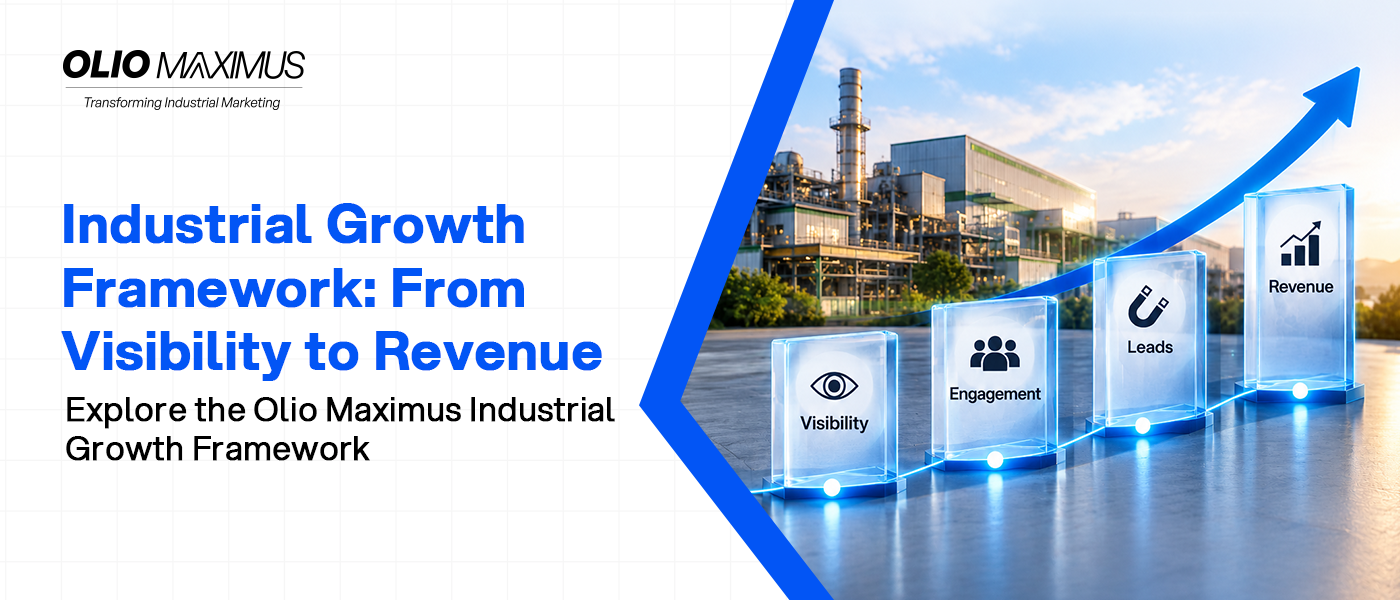
The six components aren’t separate services or a strict set of campaigns. They work together as an ongoing growth system.
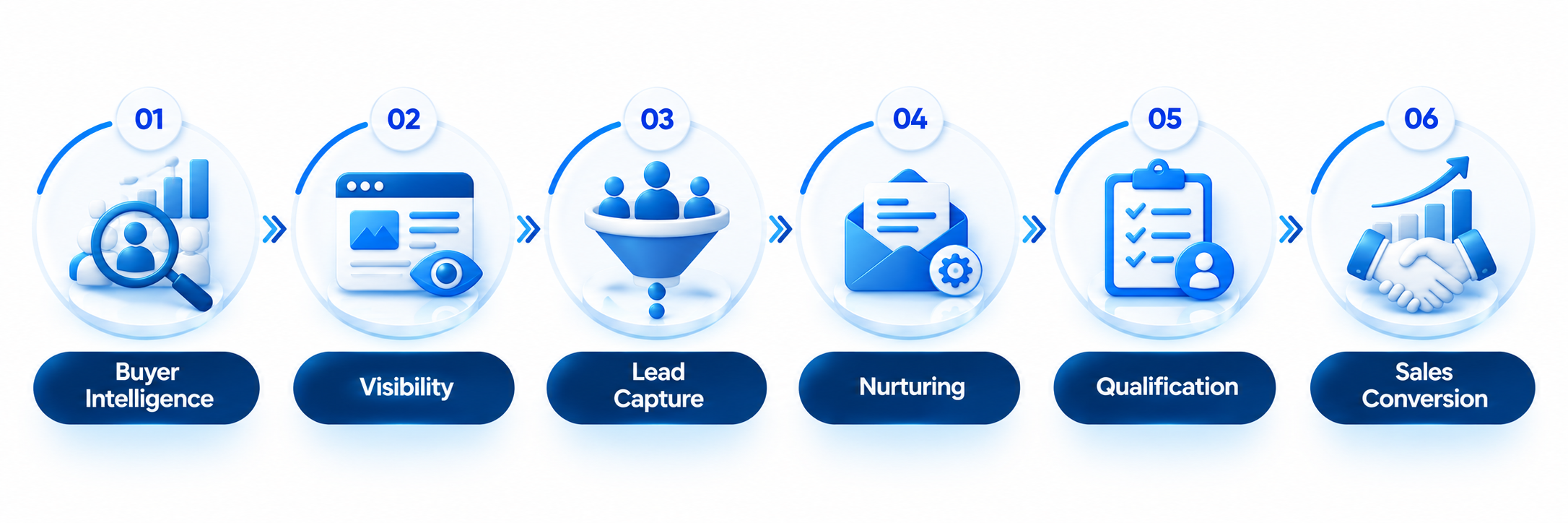
Buyer intelligence helps define your target market and guides positioning. SEO, GEO, and content build visibility. Lead capture turns interest into real opportunities. Automation keeps engagement going, and lead scoring helps you focus on the right accounts.
Sales enablement supports the conversion process, and performance data feeds back into buyer intelligence and campaign improvement.
This creates a connected process:
The framework also makes it easier to measure marketing performance.
Instead of just looking at website traffic, impressions, or enquiry numbers, manufacturers can measure:
- Qualified leads generated.
- Sales-qualified opportunities.
- Cost per qualified opportunity.
- Lead-to-opportunity conversion.
- Pipeline value and revenue contribution.
- Sales cycle progression.
This helps management see which marketing investments are actually driving business growth.
Industrial Growth Readiness Checklist
Use this checklist to identify whether your current marketing and sales activities are working as a connected growth system.
Assess Your Manufacturing Growth System
0 of 8 completed
The unchecked areas highlight potential gaps in your current growth system. Prioritise the gaps that have the greatest impact on lead quality, sales progression, and revenue visibility.
Get Your AssessmentBuild a More Predictable Growth Engine for Your Manufacturing Business
Your manufacturing capabilities lay the groundwork for growth. But to reach the right buyers, show your value, and turn interest into revenue, you need a coordinated strategy.
The Maximus Industrial Growth Framework brings all these activities together using buyer intelligence, digital visibility, demand generation, automation, and sales enablement.
At Olio Maximus, we help manufacturers and engineering businesses build growth systems tailored to their markets, products, and complex B2B sales cycles.