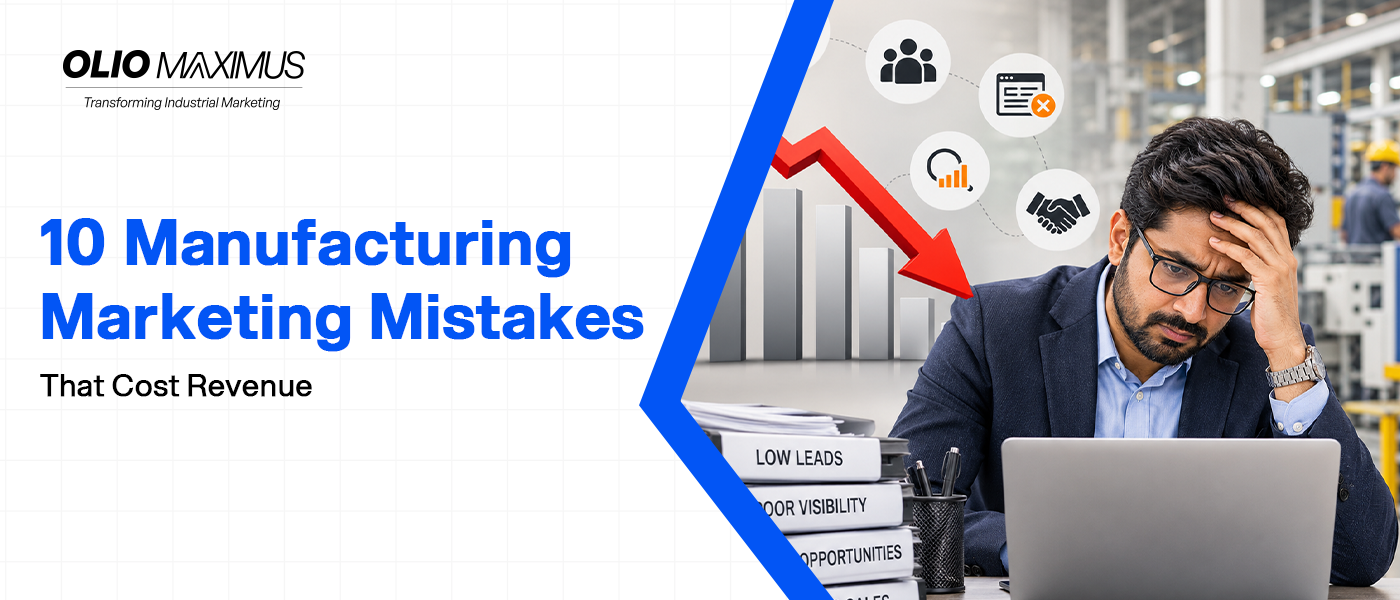
A manufacturing company can have a strong product, experienced engineers, and a capable sales team, yet still struggle to generate consistent business opportunities.
The problem isn't always the market or the competition. Sometimes, it lies in how the company approaches marketing.
Some common manufacturing marketing mistakes include:
- Broad targeting that attracts the wrong enquiries.
- Product-heavy messaging that fails to communicate business value.
- High-traffic keywords that bring visitors without buying intent.
- Websites that generate visits but few meaningful conversations.
- Marketing channels that operate independently.
- Poor lead follow-up and disconnected sales processes.
These mistakes often go unnoticed because individual campaigns might look successful on the surface.
The real impact appears in poor lead quality, wasted marketing budgets, missed opportunities, and longer sales cycles.
For Industrial Manufacturers, effective marketing isn't simply about generating more traffic or enquiries. It's about reaching the right buyers, demonstrating technical expertise, and creating opportunities that sales teams can convert.
In this blog, we explore ten common manufacturing marketing mistakes, why they affect business growth, and how to fix them.
10 Manufacturing Marketing Mistakes at a Glance
Marketing Mistake | Business Impact | What to Improve |
|---|---|---|
Targeting everyone | Irrelevant enquiries | Define ideal customer profiles |
Leading with specifications | Weak value communication | Focus on buyer outcomes |
Chasing high-volume keywords | Low-intent traffic | Target commercial search intent |
Treating websites as catalogues | Poor enquiry conversion | Build buyer-focused websites |
Hiding technical credibility | Low buyer confidence | Showcase expertise and proof |
Running channels independently | Disconnected marketing | Integrate marketing channels |
Ignoring trade show follow-ups | Lost opportunities | Create structured follow-up processes |
Using irrelevant landing pages | Wasted advertising spend | Match landing pages to buyer intent |
Abandoning unready leads | Lost future business | Implement lead nurturing |
Measuring traffic instead of revenue | Unclear marketing ROI | Track commercial outcomes |
1. Targeting Everyone Who Could Buy Your Products
Manufacturers often serve several industries, but not every potential buyer should receive the same marketing focus.
Casting too wide a net attracts enquiries from businesses with different requirements, budgets, production needs, and buying potential.
As a result, sales teams spend time pursuing prospects who may never become profitable customers.
For example, a manufacturer supplying industrial automation equipment might serve food processing, pharmaceuticals, automotive, and packaging companies. Each industry has different technical requirements and purchasing priorities.
A generic campaign targeting all industrial businesses may fail to communicate why the company's solution is relevant to any particular segment.
How to fix it:
Define your ideal customer profile (ICP) using:
- Industry and application.
- Company size and production capacity.
- Geographic location.
- Purchasing requirements.
- Expected order value.
- Technical and operational needs.
- Buying authority and decision-making structure.
Build campaigns around industries and decision-makers most likely to need your capabilities.
Key Insight
Better targeting doesn't necessarily mean reaching more businesses. It means reaching businesses with a genuine requirement for what you manufacture.
2. Leading With Machine Specifications Instead of Buyer Outcomes
Technical specifications are important, but they don't tell the entire story.
Engineers might care about machine capacity, speed, precision, or operating parameters. However, business owners and procurement teams also want to understand how those features improve production and business performance.
If your marketing focuses exclusively on specifications, buyers must work out the commercial value themselves.
Consider the difference:
Specification-Focused Messaging | Outcome-Focused Messaging |
|---|---|
Machine capacity of 100 units per hour | Supports higher production output |
Automated material handling | Reduces manual material movement |
Precision engineering | Helps maintain consistent production quality |
Energy-efficient operation | Supports lower operating energy requirements |
Custom machine configuration | Addresses specific production requirements |
How to fix it:
Connect technical features to practical business outcomes.
Explain how your machinery or engineering solutions can:
- Improve production throughput.
- Reduce material waste.
- Support product consistency.
- Address operational bottlenecks.
- Improve manufacturing efficiency.
Give buyers a reason to consider your solution beyond its specifications.
Tip
Explain what your product does, but also show why that capability matters to the buyer's production process.
3. Chasing High-Volume Keywords Instead of Buying Intent
High search volume can make keywords look attractive in SEO reports.
However, someone researching a general manufacturing process isn't necessarily looking for a supplier.
Targeting broad keywords might increase website traffic without generating relevant business enquiries.
For example, a manufacturer of industrial conveyor systems could attract very different audiences through these searches:
Broad Informational Search | Specific Commercial Search |
|---|---|
What is a conveyor system? | Industrial conveyor system manufacturer |
Types of manufacturing equipment | Custom manufacturing equipment supplier |
How automation works | Industrial automation solutions provider |
Manufacturing process explained | Custom machinery manufacturer for food processing |
Both types of searches can be valuable, but they serve different purposes in the buyer journey.
How to fix it:
Prioritise keywords related to:
- Specific industrial equipment.
- Manufacturing capabilities.
- Product applications.
- Technical problems.
- Custom engineering requirements.
- Supplier and manufacturer searches.
Build dedicated pages around these searches so prospective buyers find information relevant to their actual needs.
Explore Olio Maximus SEO Services to build an industrial SEO strategy around relevant search intent.
4. Treating Your Website Like a Digital Product Catalogue
A website that simply lists products, specifications, and company information may tell visitors what you manufacture.
But it doesn't necessarily help them evaluate your business or take the next step.
Poor navigation, vague product descriptions, limited application information, and confusing enquiry options make things harder, especially for buyers comparing several suppliers.
Your website should help potential customers understand your capabilities and determine whether your business is the right fit.
How to fix it:
Structure your website around buyer requirements.
Include:
- Dedicated product and service pages.
- Industry-specific application pages.
- Technical manufacturing capabilities.
- Product specifications and documentation.
- Customer projects and case studies.
- Certifications and quality credentials.
- Clear quotation and enquiry options.
Marcopolo's experience illustrates the importance of this foundation.
Olio Maximus repositioned the company as an integrated rapid prototyping-to-production partner, rebuilt its website, and strengthened its SEO.
The work generated 26 qualified organic enquiries and a 242% increase in Google Business Profile calls.
Marcopolo: How We Built a Digital Foundation and Scaled Organic Growth for India's Only Rapid Prototyping-to-Production Company
How we repositioned India's only integrated rapid prototyping-to-production partner — fixing perception, rebuilding their digital foundation, and generating 26 qualified organic enquiries and a 242% increase in inbound calls within 6 months.

- 26Qualified Organic Enquiries
- 242%GBP Calls Growth
- 83%Impressions Growth
Key Insight
Your website should do more than introduce your company. It should help buyers understand your capabilities, establish confidence, and take the next step.
5. Hiding Your Technical Credibility
Many manufacturers have years of engineering experience, specialised capabilities, certifications, and proven installations.
However, their marketing often relies on generic phrases such as:
- High-quality products.
- Reliable solutions.
- Industry-leading expertise.
- Advanced manufacturing capabilities.
These claims don't give buyers enough evidence to distinguish one supplier from another.
Engineering and procurement teams need reasons to trust your capabilities before considering a commercial discussion.
How to fix it:
Support your marketing claims with evidence.
Showcase:
- Relevant manufacturing projects.
- Technical documentation.
- Certifications and quality standards.
- Customer results and testimonials.
- Production and engineering capabilities.
- Application-specific experience.
- Real-world implementation examples.
Make it easy for buyers to verify your expertise.
Your Technical Capabilities Deserve to Win Better Business
Make your expertise visible to the buyers who value it. Strengthen your positioning and build a manufacturing marketing strategy that attracts relevant, sales-qualified leads.
Book a Free Consultation Call6. Running Marketing Channels Independently
SEO, paid advertising, LinkedIn, email, and video can all support manufacturing business growth.
However, when every channel operates with a separate strategy, buyers receive inconsistent messages and marketing becomes difficult to measure as a whole.
For example, a manufacturer might run Google Ads promoting a particular machine while its website contains limited application information. LinkedIn may communicate a different value proposition, and email campaigns may not address the same buyer requirements.
This creates disconnected experiences and missed opportunities.
How to fix it:
Give every marketing channel a defined role in the buyer journey.
Marketing Channel | Its Role in Industrial Marketing |
|---|---|
SEO | Helps buyers discover your products and capabilities |
Technical Content | Supports research and supplier evaluation |
Paid Advertising | Reaches relevant buyers actively searching for solutions |
Builds professional visibility and buyer relationships | |
Email Marketing | Maintains engagement and supports lead nurturing |
Video Marketing | Demonstrates products, processes, and technical capabilities |
Keep messaging consistent across all touchpoints.
An integrated approach ensures that channels support one another rather than competing for attention or operating without a common objective.
Explore Olio Maximus Integrated Marketing Services to connect your marketing channels through a coordinated strategy.
7. Exhibiting at Trade Shows Without a Follow-Up System
Trade shows provide valuable opportunities to meet engineers, distributors, procurement teams, and potential customers.
However, collecting business cards or scanning visitor badges doesn't automatically generate new business.
Without a structured follow-up process, valuable conversations can quickly lose momentum.
A prospect interested in a customised production line may require technical documentation, a quotation, or another discussion before moving forward.
If nobody follows up, that opportunity may disappear.
How to fix it:
Create a structured trade show follow-up process.
- Categorise contacts by industry, application, and buying interest.
- Record specific requirements discussed during the event.
- Assign follow-up ownership to the appropriate sales representative.
- Share relevant technical information and case studies.
- Schedule the next interaction.
- Track conversations that progress into qualified opportunities.
Not every event contact is ready to purchase immediately. The objective is to maintain relevant communication until a genuine opportunity develops.
8. Running Paid Campaigns Without Relevant Landing Pages
Paid advertising can bring the right audience to your website, but sending everyone to your homepage can weaken campaign performance.
Imagine an engineer searching for a custom industrial packaging machine.
They click an advertisement expecting information about that specific solution, but land on a general company homepage.
They now have to navigate through the website to find relevant details.
This additional effort can reduce the likelihood of an enquiry.
How to fix it:
Create dedicated landing pages that match the advertisement's audience, message, and search intent.
Each landing page should include:
- A clear headline related to the search.
- Relevant product or application information.
- Technical capabilities and specifications.
- Supporting case studies or customer proof.
- A clear quotation or enquiry action.
Measure conversions and lead quality rather than relying on clicks alone.
Tip
Every paid campaign should take buyers to a page that directly addresses what they searched for.
9. Abandoning Leads That Aren't Ready to Buy
Industrial purchases often involve technical reviews, internal approvals, budget planning, and several decision-makers.
Someone who enquires about your machinery today might not be ready to purchase for several months.
Treating every lead that doesn't convert immediately as a lost opportunity can weaken your sales pipeline.
For example, a procurement manager researching a new production line may initially request a brochure. After technical evaluation and internal discussions, the company might return for a quotation several months later.
Without consistent communication, your business may no longer be part of the consideration process.
How to fix it:
Implement a structured lead-nurturing process.
- Segment prospects according to interest and buying stage.
- Share relevant case studies and application insights.
- Provide useful technical resources.
- Send product updates where relevant.
- Schedule appropriate sales follow-ups.
- Reconnect when prospects demonstrate stronger buying intent.
Not every lead needs an immediate sales call. Some need relevant information and time to progress through their buying journey.
10. Measuring Traffic Instead of Commercial Outcomes
Website traffic, impressions, followers, and clicks show that your marketing is active.
But they don't necessarily indicate that your business is generating meaningful opportunities.
If you only measure these numbers, you might continue investing in campaigns that attract attention but fail to generate qualified business.
This makes it difficult to understand your actual marketing ROI.
How to fix it:
Connect marketing reporting with commercial outcomes.
Marketing Metric | Business Metric |
|---|---|
Website traffic | Relevant website visitors |
Enquiry volume | Qualified leads |
Campaign clicks | Cost per qualified lead |
Content engagement | Relevant buyer interactions |
Lead generation | Sales-qualified opportunities |
Marketing conversions | Pipeline contribution |
Campaign performance | Revenue contribution |
Use CRM data and campaign tracking to understand which channels generate commercially valuable opportunities.
Review performance regularly and adjust marketing investment according to lead quality, conversion rates, and business outcomes.
Key Insight
Marketing performance should be measured by its contribution to business opportunities, not simply by the amount of activity it generates.
How to Identify Which Marketing Mistakes Are Costing Your Business
You don't need to begin with a complete marketing strategy overhaul.
Start by reviewing five important areas of your existing marketing activities.
Area | Questions to Ask |
|---|---|
Targeting | Are campaigns reaching the industries and decision-makers you want to sell to? |
Positioning | Can buyers understand what makes your manufacturing capabilities different? |
Conversion | Does your website turn relevant visits into meaningful enquiries? |
Follow-up | Are prospects receiving relevant communication throughout their buying journey? |
Measurement | Can you connect marketing investment to qualified opportunities and sales outcomes? |
Check for gaps between each stage.
You might reach the right audience through a campaign, but unclear website messaging can prevent visitors from making enquiries.
Even if your business generates numerous enquiries, poor qualification can create problems for the sales team.
Finding the actual bottleneck allows you to focus on what needs fixing rather than spending more money on activities that aren't delivering results.
Manufacturing Marketing Health Check
Assess whether your current marketing strategy is supporting business growth.
0 of 10 completed
Need help with the unchecked steps?
Talk To Our TeamAssessment: If several areas remain unchecked, your business may have gaps between marketing activity, lead generation, and sales conversion.
Start with the areas that have the greatest impact on lead quality and pipeline progression.
How to Turn Manufacturing Marketing Into a Revenue System
Fixing individual marketing problems is important, but sustainable growth requires your activities to work together.
A connected industrial marketing strategy should:
- Define your positioning: Establish what makes your manufacturing capabilities valuable to specific industries and buyers.
- Attract relevant buyers: Use SEO, paid advertising, and technical content to improve visibility.
- Convert interest into enquiries: Build websites and landing pages that make it easy for potential buyers to take action.
- Nurture potential customers: Maintain relevant communication throughout longer industrial buying cycles.
- Support sales conversion: Equip sales teams with technical information, case studies, and buyer insights.
- Measure commercial performance: Track qualified leads, pipeline contribution, conversion rates, and revenue outcomes.
This is why an integrated industrial marketing approach matters.
Rather than treating each channel independently, manufacturers can connect marketing activities around buyer behaviour and business objectives.
How Olio Maximus Helps Manufacturers Build Revenue-Focused Marketing Systems
Olio Maximus helps Industrial Manufacturers, OEMs, and Engineering Companies connect their marketing activities through a structured growth approach.
Our capabilities include:
Industrial SEO: Improve search visibility for relevant products, applications, and manufacturing capabilities.
Content Marketing: Develop technical articles, industry guides, and case studies that demonstrate expertise.
Integrated Marketing: Connect SEO, paid search, LinkedIn, email, and other marketing channels.
Demand Generation: Reach relevant industrial buyers and create qualified business opportunities.
Lead Generation and Sales Enablement: Strengthen lead capture, qualification, nurturing, and sales processes.
Explore Olio Maximus Integrated Marketing Services to understand how these capabilities can work together.