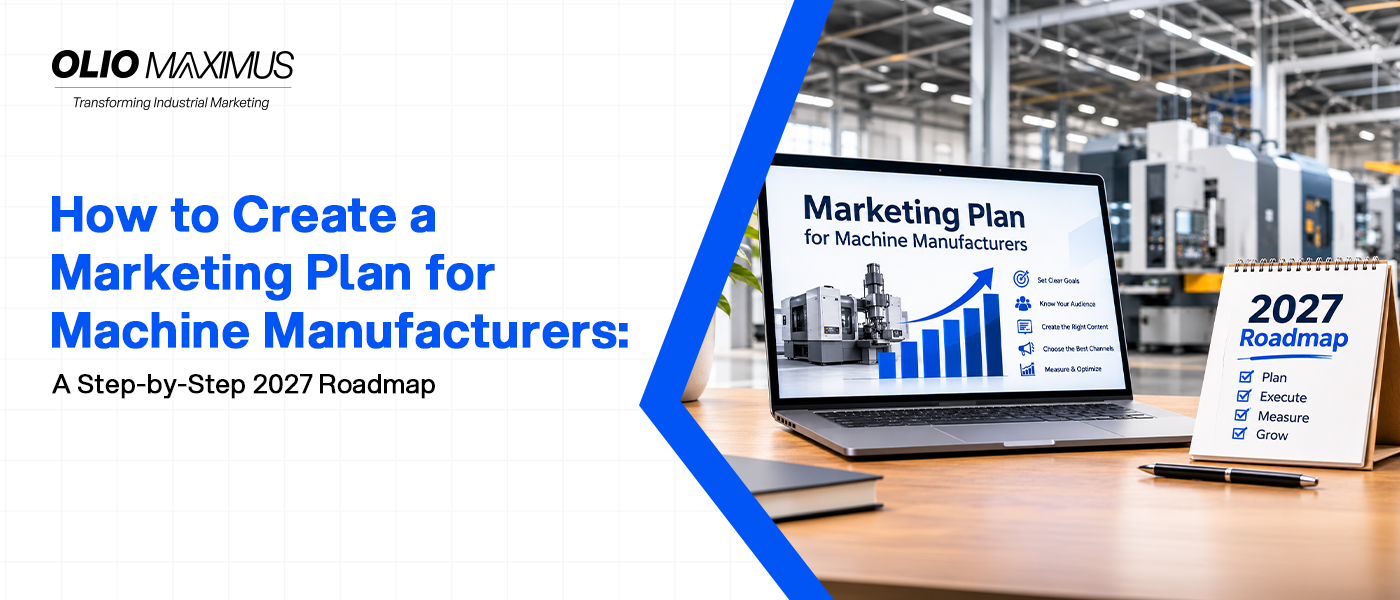
A new year gives machine manufacturers an opportunity to reassess their markets, sales targets, and growth priorities. But creating a marketing plan often starts with choosing activities: publish more blogs, run LinkedIn campaigns, invest in SEO, or attend trade shows.
The problem is that these activities don't automatically translate into business growth.
An effective manufacturing marketing plan starts with business goals. It identifies which markets the company wants to penetrate, which buyers it needs to reach, what those buyers expect from suppliers, and which marketing activities can help generate qualified opportunities.
For machine manufacturers planning 2027, the objective should be to create a roadmap that connects marketing investment with sales priorities, buyer behaviour, and measurable business outcomes.
This guide explains how to build a practical manufacturing marketing strategy, from defining revenue goals and selecting marketing channels to planning campaigns, allocating budgets, and measuring performance.
2027 Manufacturing Marketing Plan: Key Areas to Cover
Before developing individual campaigns, establish the major areas your annual marketing strategy needs to address.
Planning Area | What to Define |
|---|---|
Business Goals | Revenue, sales and customer acquisition targets |
Target Markets | Priority industries, geographical markets and OEM accounts |
Buyer Journey | How potential customers research and evaluate suppliers |
Brand Positioning | Manufacturing strengths and competitive differentiation |
Marketing Channels | SEO, LinkedIn, content, paid advertising and email |
Campaign Calendar | Annual priorities, activities and timelines |
Marketing Budget | Channel investment and execution costs |
Performance Measurement | Leads, pipeline, conversions and revenue contribution |
These areas create the foundation for a coordinated marketing plan rather than a collection of disconnected activities.
1. Set Your Business and Revenue Goals for 2027
Before deciding what marketing should do, establish what the business wants to achieve.
A machine manufacturer may want to increase sales of a particular machine category, enter a new industry, expand into another geographical market, generate more enquiries for customised equipment or reduce dependence on referrals.
These priorities should determine the direction of the marketing plan.
For example, a manufacturer looking to enter the food processing industry may need industry-specific positioning, targeted content, relevant case studies and campaigns that reach food processing decision-makers.
A company looking to increase sales of an existing product may need stronger search visibility, better product pages and lead generation campaigns.
Start by defining:
- Revenue or sales targets for the year.
- Products or product categories to prioritise.
- Industries and geographical markets to pursue.
- New customer acquisition targets.
- Pipeline and enquiry generation goals.
- Existing business or customer expansion opportunities.
Your marketing objectives should directly support these business priorities.
2027 Marketing Goal-Setting Framework
Business Objective | Marketing Priority | Expected Outcome |
|---|---|---|
Enter a new industry | Industry-focused campaigns and content | Relevant market visibility |
Increase machine sales | Product SEO and targeted advertising | More product enquiries |
Expand geographically | Regional SEO and targeted campaigns | Visibility in priority markets |
Acquire OEM customers | Account-based marketing and prospecting | Relevant enterprise opportunities |
Reduce referral dependency | Integrated demand generation | Additional lead sources |
Key Insight
Marketing goals should come from business growth priorities, not from a list of activities you want to execute.
2. Identify the Markets and Buyers You Want to Reach
Not every industry, company, or buyer represents an equally valuable opportunity.
Machine manufacturers should identify the markets where their capabilities, products, and commercial proposition are most competitive.
This involves understanding the industries they serve, applications their machines support, company sizes they can target, and the decision-makers involved in purchasing.
Your ideal customer profile should consider:
- Industry and application.
- Company size and production requirements.
- Potential order value.
- Geographical location.
- Existing machinery or infrastructure.
- Purchase triggers and business challenges.
This analysis helps prioritise marketing investment rather than spreading it across audiences with different needs and purchasing potential.
For example, a manufacturer specialising in automated packaging machinery may prioritise food processing and pharmaceutical companies rather than targeting every business involved in manufacturing.
An industrial marketing roadmap built around clearly defined target markets makes it easier to create relevant messaging, select channels and generate more qualified enquiries.
Target Market Prioritisation
Evaluation Factor | Questions to Consider |
|---|---|
Industry Fit | Does the industry require your machinery or capabilities? |
Application Fit | Can your equipment address its production requirements? |
Commercial Potential | Does the market offer suitable order value and growth opportunities? |
Geographic Fit | Can you realistically serve customers in this region? |
Buyer Accessibility | Can you identify and reach relevant decision-makers? |
3. Understand the Industrial Buyer Journey
Industrial buyers don't usually select machinery after seeing a single advertisement.
They research requirements, compare suppliers, evaluate technical capabilities, consult stakeholders and assess commercial viability before making a decision.
Your marketing plan should account for these stages.
Buyer Stage | What Buyers Are Doing | Marketing Support |
|---|---|---|
Problem Recognition | Identifying production challenges or new requirements | Educational content and industry insights |
Research | Exploring technologies, solutions and specifications | SEO, technical blogs and product information |
Supplier Discovery | Identifying potential manufacturers | Search visibility, industry directories and LinkedIn |
Evaluation | Comparing capabilities, applications and suppliers | Case studies, technical resources and demonstrations |
Decision | Assessing commercial and operational suitability | Sales enablement, consultations and follow-up |
A buyer researching a production problem may need educational content. Someone comparing machinery suppliers may want application details, technical capabilities, and evidence of successful installations.
Planning around the buyer journey ensures marketing isn't focused only on generating initial attention.
Planning Your 2027 Marketing Strategy?
Build a marketing roadmap around your target markets, sales objectives, buyer behaviour, and opportunities for industrial growth.
Book a FREE Consultation Call4. Define Your Positioning and Messaging
Before launching campaigns, establish why buyers should consider your company instead of competing manufacturers.
Many machine manufacturers communicate similar messages: high quality, advanced technology, reliable machines, and customer support.
These claims rarely provide enough differentiation on their own.
Your positioning should reflect your actual strengths.
Consider:
- Specialised applications or industries you serve.
- Customisation and engineering capabilities.
- Production expertise.
- Installation, integration, or after-sales support.
- Proven project experience.
- Operational or commercial advantages your solutions offer.
Your messaging should communicate these strengths in terms buyers understand.
For example, instead of simply promoting a machine's specifications, explain how its capabilities address a production requirement, improve efficiency, support product quality, or solve an operational challenge.
Generic Messaging vs Buyer-Focused Messaging
Generic Messaging | Buyer-Focused Messaging |
|---|---|
High-quality machinery | Machinery designed for specific production requirements |
Advanced technology | Automation capabilities that address operational bottlenecks |
Reliable solutions | Engineering and support capabilities that help maintain operations |
Customer satisfaction | Application-specific solutions backed by relevant project experience |
Consistent positioning should guide your website, campaigns, content, sales presentations, and other marketing materials.
5. Choose Marketing Channels Based on Buyer Behaviour
A manufacturing marketing plan should not allocate resources to channels simply because competitors are using them.
The right channels depend on where your target buyers research suppliers, what information they need, and how your company can reach them effectively.
Search Engine Optimisation
SEO helps machine manufacturers appear when buyers search for equipment, applications, technical solutions and suppliers.
Prioritise product, application, industry and buyer-intent searches rather than relying exclusively on broad keywords.

Search Engine Optimization (SEO)
Industrial buyers thoroughly research before they buy. Is your company visible when they evaluate options?
Content Marketing
Technical blogs, application guides, case studies and comparison content help buyers understand your capabilities and evaluate solutions throughout the purchasing process.
LinkedIn Marketing
LinkedIn can help manufacturers reach relevant business audiences, build credibility, share technical insights, and engage decision-makers.
Paid Advertising
Paid search and targeted campaigns can support specific product categories, markets, applications, or demand-generation objectives when the audience and landing pages are properly defined.
Email Marketing and Lead Nurturing
Email can help maintain engagement with prospects who have shown interest but are not ready to purchase. Relevant content and timely follow-up support longer industrial buying cycles.
Industrial Video
Product demonstrations, machine walkthroughs, application videos, and customer stories can help buyers understand capabilities that may be difficult to communicate through text alone.

Industrial Video Production
Establish Trust and Win Buyers with Effective, Results-Driven Industrial Video Production Services
Choosing the Right Marketing Channels
Marketing Channel | Primary Role | Best Used For |
|---|---|---|
SEO | Organic search visibility | Capturing relevant product and supplier searches |
Content Marketing | Expertise and education | Supporting buyer research and evaluation |
Professional visibility | Reaching industrial decision-makers | |
Paid Advertising | Targeted reach | Promoting priority products and campaigns |
Email Marketing | Ongoing engagement | Nurturing longer-term prospects |
Industrial Video | Visual communication | Demonstrating machinery and applications |
The objective isn't to use every channel. It is to select a combination that supports your business goals and target buyer journey.
Integrated Marketing Services | Olio Maximus
If your marketing channels are working separately, they are missing the chance to support each other. You can either coordinate them or let them compete for the same budget. Olio MaXimus creates integrated marketing services for B2B companies, making sure each channel supports the others and helps move qualified buyers forward.
6. Build Your Annual Campaign Calendar
Once priorities and channels are defined, organise your activities into an annual campaign plan.
Instead of planning each activity independently, group campaigns around business priorities, product categories, target industries or seasonal opportunities.
Example 2027 Manufacturing Marketing Calendar
Quarter | Marketing Focus | Potential Activities |
|---|---|---|
Q1 | Establish visibility | Website improvements, SEO and priority product campaigns |
Q2 | Expand market reach | Industry-specific content and targeted campaigns |
Q3 | Generate demand | Lead nurturing, paid campaigns and sales engagement |
Q4 | Review and optimise | Performance evaluation, pipeline development and next-year planning |
The actual calendar should reflect your sales cycle, industry events, product launches, target markets and available resources.
Your campaign planning should also account for dependencies.
A paid campaign may require a landing page, technical content and sales follow-up before launch. An SEO campaign may require several months of content development and optimisation before meaningful results emerge.
Plan activities with enough time for preparation, execution and measurement.
7. Allocate Your Marketing Budget
Your marketing budget should reflect business priorities rather than simply repeating last year's spending.
Start by assessing existing marketing performance. Identify which channels generate qualified enquiries, which activities support sales, and which investments produce little measurable value.
Budget allocation should consider:
- Business and revenue goals.
- Priority products and target markets.
- Existing channel performance.
- Required website or content improvements.
- Campaign production and execution costs.
- Paid media investment.
- Marketing technology and tools.
- Resources required for lead follow-up and sales enablement.
A manufacturer entering a new industry may need to invest more in market research, positioning and industry-specific content.
A business with strong organic visibility but low enquiry conversion may need to prioritise website improvements and conversion optimisation.
Marketing Budget Planning Framework
Budget Category | What to Account For |
|---|---|
SEO and Website | Technical improvements, optimisation and website development |
Content Marketing | Blogs, case studies, technical resources and creative production |
Paid Advertising | Search campaigns and targeted advertising |
Social Media | LinkedIn content and campaign management |
Video Marketing | Product demonstrations and industrial videos |
Marketing Technology | Analytics, CRM and marketing tools |
Lead Generation | Prospecting, qualification and sales enablement |
There is no universal budget percentage that works for every manufacturer. Allocate investment according to your priorities, available resources and expected commercial outcomes.
Avoid allocating the entire budget to lead generation campaigns without accounting for the content, website, positioning and follow-up systems needed to convert demand into opportunities.
8. Set KPIs and Review Performance
A marketing plan should establish how success will be measured before campaigns begin.
Traffic, impressions, and engagement can help assess visibility. But they should not be the only indicators of performance.
Your marketing plan for growing your manufacturing company should track metrics that connect marketing activity to commercial outcomes.
Objective | KPIs to Track |
|---|---|
Improve Visibility | Organic traffic, search impressions, keyword visibility |
Generate Demand | Qualified enquiries, leads by channel, conversion rates |
Improve Lead Quality | Sales-accepted leads, qualified opportunities |
Build Pipeline | Pipeline value, opportunities created, meetings generated |
Improve Efficiency | Cost per qualified lead, campaign cost, conversion efficiency |
Support Revenue | Revenue contribution, marketing-influenced opportunities, sales cycle progression |
Review performance regularly rather than waiting until the end of the year.
Monthly reviews can identify underperforming campaigns, while quarterly reviews can help reassess channel investment, market priorities and campaign direction.
Key Insight
A successful manufacturing marketing plan measures more than marketing activity. It connects visibility and engagement with qualified opportunities and business outcomes.
9. Turn Your Marketing Roadmap into an Executable Growth Plan
A strategy is useful only when you can execute it consistently.
Your final annual marketing strategy should bring together:
- Business and revenue objectives.
- Target industries, markets, and buyer profiles.
- Positioning and messaging.
- Channel strategy.
- Annual campaign calendar.
- Marketing budget.
- KPIs and reporting framework.
- Roles, responsibilities and execution timelines.
This creates a shared roadmap for marketing and sales.
It also helps businesses understand why each activity is being undertaken, which outcome it supports, and how performance will be evaluated.
For machine manufacturers, the strongest marketing plans are not necessarily the ones with the most campaigns. They are the ones where every activity has a defined purpose, the right resources, and a clear connection to business growth.
2027 Manufacturing Marketing Plan Readiness Checklist
Use this checklist to assess whether your marketing strategy is prepared for the year ahead.
Checklist: Is Your Manufacturing Marketing Plan Ready for 2027?
0 of 10 completed
Need help planning your 2027 marketing strategy?
Get Your Growth Assessment With Olio MaximusAssessment: If several areas remain unchecked, your 2027 marketing strategy may need further planning before campaign execution.
Start by prioritising the gaps that affect your ability to reach relevant buyers, generate qualified opportunities, and measure business performance.
How Olio Maximus Helps Machine Manufacturers Build Growth-Focused Marketing Strategies
Creating an effective manufacturing marketing plan requires more than selecting channels and scheduling campaigns.
It requires a clear understanding of the business, target markets, buyer behaviour, competitive positioning and commercial objectives.
Olio Maximus helps Industrial Manufacturers, Machine Manufacturers, OEMs and Engineering Companies develop integrated marketing strategies that connect digital visibility with demand generation and business growth.
Our capabilities include:
Industrial SEO: Improve search visibility for relevant products, applications and manufacturing capabilities.
Content Marketing: Develop technical articles, industry guides, application content and case studies that demonstrate expertise.
Integrated Marketing: Connect SEO, paid advertising, LinkedIn, email and content marketing through a coordinated strategy.
Demand Generation: Reach relevant industrial buyers and create qualified business opportunities.
Lead Generation and Sales Enablement: Support prospecting, lead qualification, nurturing and sales engagement.
Our focus is to help manufacturers move beyond disconnected marketing activities and build a structured growth system aligned with their business objectives.
Make 2027 the Year Your Marketing Creates More Industrial Business Opportunities
Your manufacturing marketing plan should do more than keep your marketing team busy.
It should help your business reach the right industries, communicate its capabilities, attract relevant buyers and create opportunities that contribute to revenue growth.
A well-planned strategy connects business objectives with target audiences, appropriate marketing channels, realistic budgets and measurable performance.
At Olio Maximus, we help Industrial Manufacturers and Machine Manufacturers develop integrated marketing strategies that support stronger visibility, qualified lead generation and sustainable business growth.
Ready to plan your next phase of industrial growth?