A manufacturing company wants to boost output with a new production line. The operations head looks into equipment options, the engineering team checks technical specs, procurement compares suppliers, and finance reviews the investment.
Often, by the time a company reaches out to a manufacturer, it already has a shortlist of possible suppliers.
This is how most industrial purchases work today. Buyers do their own research, talk with colleagues, compare solutions, and check out suppliers before having any serious sales conversations.
Manufacturers need to understand this process. Your marketing should reach buyers early, answer their questions as they evaluate options, and give them confidence to consider your business when it’s time to decide.
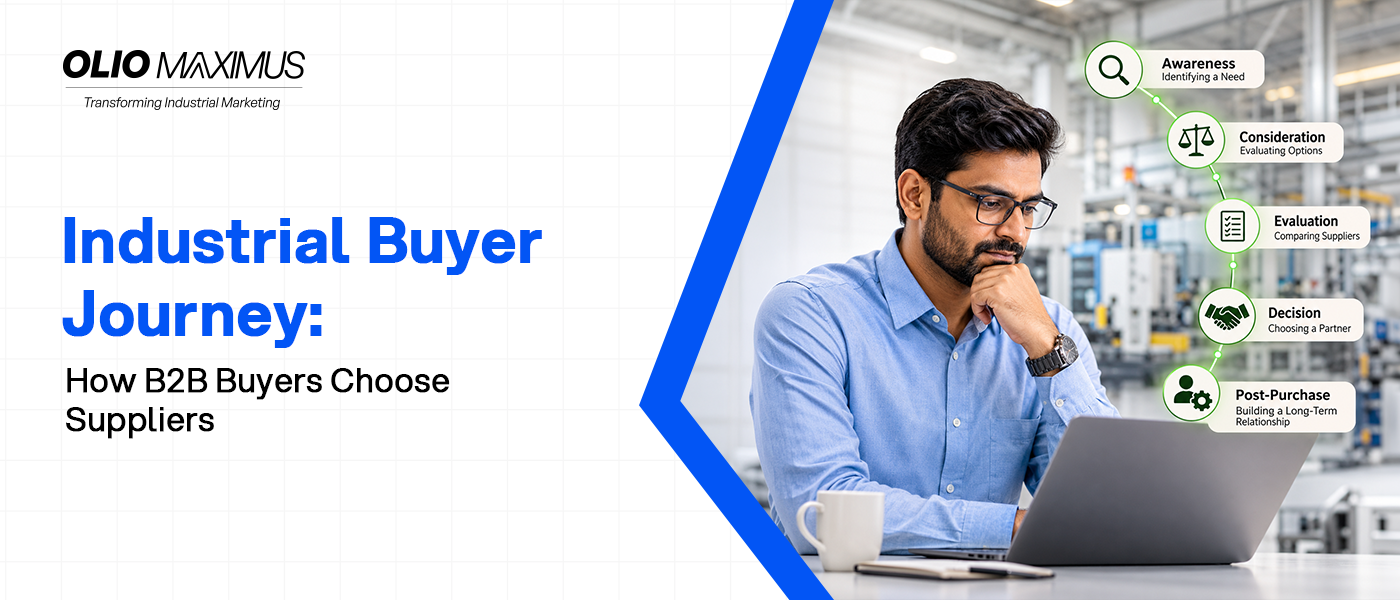
This is the industrial buyer journey: a series of research, evaluation, and decision-making steps that help businesses identify what they need and choose a manufacturing partner.
How the Industrial Buyer Journey Has Changed
Industrial buyers now have more information at their fingertips than ever before. They can research machinery, compare technical features, browse supplier websites, watch product demos, and use AI tools to look into possible solutions.
Gartner’s March 2026 research found that 67% of B2B buyers prefer a rep-free buying experience. Its survey of 646 B2B buyers also found that 45% had used AI during a recent purchase.
This shows a move toward more independent research, supported by digital tools.
Still, buyers need supplier expertise to see if a solution will work in their own environment. Questions about product fit, integration, support, and commercial details often need direct conversations.
So, the industrial procurement process includes both independent research and important conversations with suppliers.
By understanding these stages, manufacturers can see where buyers need information and how their marketing can help influence the supplier choice.
The Six Stages of the Industrial Buyer Journey
The industrial buyer journey doesn’t always follow a straight path. Buyers might go back to earlier steps, look at new suppliers, or bring in more people as their needs become clearer.
However, most complex manufacturing purchases go through six main stages.
1. Problem Recognition and Requirement Identification
The journey starts when a business spots an operational need or problem.
A manufacturing plant might deal with production bottlenecks, higher operating costs, uneven product quality, or limited capacity. The team then looks for ways to solve the problem.
At this stage, buyers often don’t know which machine, technology, or supplier can fix the issue.
What buyers look for:
- Possible solutions to operational challenges.
- Ways to improve productivity and production efficiency.
- Technologies that address specific manufacturing requirements.
- Information about the cost and impact of existing limitations.
How manufacturers can influence this stage:
Share educational content that links operational challenges to possible solutions. Industry guides, practical blogs, explainer videos, and real-world insights can help buyers see their options.
For example, a manufacturer supplying automated packaging equipment could publish content explaining how automation addresses packaging bottlenecks and reduces manual intervention.
The goal is to be a helpful source of information before buyers start comparing suppliers.
2. Independent Research and Solution Exploration
Once buyers know what they need, they start looking at the solutions available.
They search on Google, visit manufacturer websites, read industry articles, watch demos, and more often use AI-powered search tools to find possible suppliers.
They might also talk to industry peers and check recommendations from current customers.
What buyers look for:
- Available technologies and solution types.
- Manufacturers with relevant industry experience.
- Product capabilities and technical specifications.
- Applications, limitations and implementation requirements.
- Evidence of successful installations.
How manufacturers can influence this stage:
Turn your website into a helpful research tool. Organize product details clearly, share in-depth technical content, and show how your solutions fit specific needs.
Search engine optimization is important too. Your products and expertise should show up when potential customers look for machinery, manufacturing solutions, or suppliers.
Your online presence should help buyers see what you offer, so they don’t have to contact sales for every simple question.
3. Supplier Discovery and Shortlisting
After looking at possible solutions, buyers begin to pick out manufacturers who seem able to meet their needs.
This is when supplier evaluation gets more focused.
A company purchasing an industrial processing line may shortlist manufacturers based on production capacity, customisation capabilities, industry experience, location, service support and overall suitability.
Forrester’s 2026 State of Business Buying research highlights the complexity behind these decisions. A typical B2B buying group involves 13 internal stakeholders and nine external influencers.
Different people bring their own views, so choosing a supplier becomes a team effort.
What buyers look for:
- Relevant manufacturing experience.
- Proven product and engineering capabilities.
- Customer references and case studies.
- Certifications and quality credentials.
- Service networks and after-sales support.
- Consistency between website claims and supplier communication.
How manufacturers can influence this stage:
Build trust by showing real evidence instead of making broad promotional claims.
Publish detailed case studies, customer testimonials, manufacturing capabilities, certifications and application-specific product information.
Make it easy for potential buyers to understand what differentiates your business from other manufacturers.
4. Technical and Commercial Evaluation
Once suppliers are on the shortlist, buyers check if their solutions really meet the requirements.
This stage includes in-depth technical and commercial discussions.
Engineering teams may review machine specifications, material compatibility, operating parameters, integration requirements and maintenance needs. Procurement evaluates quotations, payment terms and supplier commitments.
Finance examines the investment against expected business outcomes.
What buyers look for:
- Technical compliance with project requirements.
- Production capacity and expected performance.
- Total cost of ownership.
- Installation and commissioning requirements.
- Maintenance, spare parts and service availability.
- Delivery schedules and commercial terms.
How manufacturers can influence this stage:
Provide detailed product documentation, application-specific proposals, technical consultations and transparent commercial information.
Where possible, offer demonstrations, product trials or factory visits to help buyers validate performance.
At this point, sales teams should focus on understanding the buyer’s needs, not just giving standard product presentations.
Quick quiz
According to Forrester's 2026 research, how many internal stakeholders are typically involved in a B2B buying group?
5. Internal Approval and Final Supplier Selection
Just because a solution is technically suitable doesn’t mean it will get a purchase order.
The preferred solution must still pass internal reviews, budget approvals and procurement requirements.
Forrester’s 2026 research found that procurement professionals act as decision-makers in 53% of business buying cycles. Their involvement can extend beyond price comparisons to assessing functionality, productivity and overall value.
At this stage, the buying team needs to feel sure the chosen manufacturer can deliver what was promised.
What buyers look for:
- A clear business case and expected return on investment.
- Confidence in supplier reliability.
- Acceptable commercial and contractual terms.
- Implementation and delivery commitments.
- Evidence that operational risks have been considered.
How manufacturers can influence this stage:
Support your main contact in making a strong case for the purchase inside their company.
Provide ROI calculations, implementation plans, technical justifications and relevant customer results. Ensure the information your marketing and sales teams share stays consistent.
Your job is to reduce uncertainty and help decision-makers feel confident about justifying the investment.
Tip
Help buyers justify their purchase internally with clear ROI calculations, technical evidence, and relevant customer success stories.
Ensure Your Business Is Picked by Buyers When Search Online
Get your brand in front of industrial decision-makers through targeted SEO, strategic content and demand generation campaigns that build visibility before the first sales conversation.
Get on Their Radar6. Purchase, Implementation and Supplier Validation
The purchase order is a big step, but the buyer’s experience doesn’t end there.
The manufacturer now needs to deliver the agreed equipment or solution, meet the technical specs, and provide installation, commissioning, and support.
The buyer evaluates whether the supplier has delivered on its commitments.
This experience can affect future purchases, repeat business, and whether the buyer recommends the supplier to others.
What buyers look for:
- Delivery against agreed specifications.
- Smooth installation and commissioning.
- Reliable technical and after-sales support.
- Availability of spare parts and maintenance.
- Consistent product performance.
How manufacturers can strengthen the relationship:
Keep in touch with customers after the sale, respond quickly to their needs, and make sure you deliver on your service promises.
Record successful installations and customer results, as long as you have their permission. Sharing these stories can help future buyers learn more about your business.
What the Industrial Buyer Journey Means for Manufacturing Marketing
When you understand how industrial buyers make decisions, you can adjust your marketing approach to fit their needs.
A website visit, downloading a brochure, or making an enquiry is just one step in a much bigger decision-making process.
Your marketing should help buyers at every stage, not just focus on getting enquiries.
Here are four priorities to consider:
- Build visibility before buyers contact suppliers: Invest in SEO, industry-specific content and digital channels that help potential customers discover your business during early research.
- Address the needs of different stakeholders: Develop content for engineering, operations, procurement and finance teams rather than communicating only with the primary contact.
- Demonstrate capabilities with evidence: Use case studies, technical documentation, product demonstrations and customer results to establish credibility.
- Connect marketing with sales: Ensure that sales teams understand how prospects have interacted with your brand and have access to relevant information for their next conversation.
Manufacturers who understand how buyers think can make smarter choices about where to spend their marketing budget and how to help customers through the buying process.
Industrial Buyer Journey Readiness Checklist
0 of 7 completed
Need help improving your manufacturing buyer journey?
Talk to Our TeamGet Your Manufacturing Brand in Front of Buyers Before the Purchase Decision
When an industrial buyer asks for a quote, they have often already done most of their research on suppliers.
Your brand should show up when buyers are researching, be trustworthy when they compare options, and stand out when they make their final choice.
At Olio Maximus, we work with manufacturing and industrial businesses to create marketing strategies that match how their customers really research, compare, and buy solutions.
We use tools like industrial SEO, content marketing, account-based marketing, and targeted demand generation to help your business connect with the right decision-makers and get noticed before buyers send formal enquiries.